Content levels
Trigger warnings
Not yet taggedPositive tags
Not yet taggedTropes
Not yet taggedThemes
Not yet taggedSynopsis
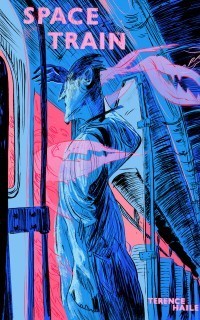
Terence Haile’s Space Train, first published in 1962, is an exemplary product of its time, and of the explosion of scifi that began flooding the UK in the postwar era. It all tended to be rather mild-mannered, even when things were going horribly wrong: very English. Think John Wyndham and his contemporaries. The general sense, no doubt resulting from upper lips still stiff from WII, was that there might be some unpleasantness (alien invasions, brand new planets appearing in Earth’s orbit, plants rising up to destroy humanity, rationing) but that it would all be fine if everyone just helped out their neighbors and didn’t make too much of a fuss. England in the 50’s and early 60’s was still working through the uneasy truce, begun in the Industrial Revolution, between a desire for innovation and modernization and the bucolic, rural values of “traditional” England. Progress—it’s great, right? But who will milk our cows? Won’t it be awfully loud? All this science and machinery, it’s just not…how we do things, dear. The clash between these two attitudes is reflected pretty clearly in almost all the literature of the time, and Space Train is no exception—although it goes in a slightly different direction with it, no pun intended. This is the story of a simple farm boy who builds a train that can travel at over 3,000 mph along the ground, aided by...well, some sort of magnetized field. The plot, and its entertainment value, is enhanced greatly by some rather large, but understandable, gaps in the scientific knowledge of the time--or possibly of the author. Sonic booms? Escape velocity? Huh? Not a problem. We don’t need to tell you what eventually happens to our farm boy’s amazing creation; the book is called Space Train for a reason, guys. It’s an incredibly fun field trip to a simpler time, when men were men, women were little girls who didn’t understand engines (to be fair, a lot of the men apparently didn’t understand them either), everyone trusted their neighbors, and