Content levels
Trigger warnings
Not yet taggedPositive tags
Not yet taggedTropes
Not yet taggedThemes
Not yet taggedSynopsis
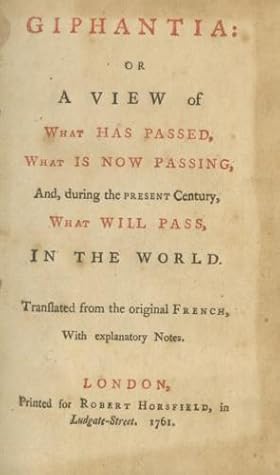
"In 1760 the French writer Charles François Tiphaigne de la Roche wrote a novel that today would be considered science fiction. Titled Giphantie, an anagram of his name, it describes his imaginary travels. He was lifted into the air and transported half unconscious, to a beautiful garden in a strange land. There he met a Spirit who said, 'I am the Prefect of this island which is called Giphantie.' With the Prefect as guide, Tiphaigne explored the wonders of 'the island.'" In GIPHANTIA, Chapter XVII, Part I, The author prophecies the fixing of transient images of nature by the action of light. "Thou knowest that the rays of light, reflected from different bodies, make a picture and paint the bodies upon all polished surfaces, on the retina of the eye, for instance, on water, on glass. The elementary spirits have studied to fix these transient images: they have composed a most subtle matter, very viscous, and proper to harden and dry, by the help of which a picture is made in the twinkle of an eye. They do over this matter a piece of canvas, and hold it before the objects they have in mind to paint. The first effect of the canvas is that of a mirror; there are seen upon it all the bodies far and near, whose image the light can transmit. But what the glass cannot do, the canvas, by means of the viscous matter, retains the images. The mirror shows the objects exactly; but keeps none; our canvases show them with the same exactness, and retains them all. This impression of the images is made the first instant they are received on the canvas, which is immediately carried away into some dark place; an hour after, the subtle matter dries, and you have a picture so much the more the valuable, as it cannot be imitated by art nor damaged by time." This is considered a cornerstone book in any collection of photographic literature, and photography's first fictional work.